From Macroscopic Quantum Tunneling to Quantum Keys: How the Nobel Prize Will Secure BCIs
Inspired by Martinis, Clarke, and Devoret’s Nobel-winning work on Macroscopic Quantum Tunneling, a deep dive into where physics meets network security.
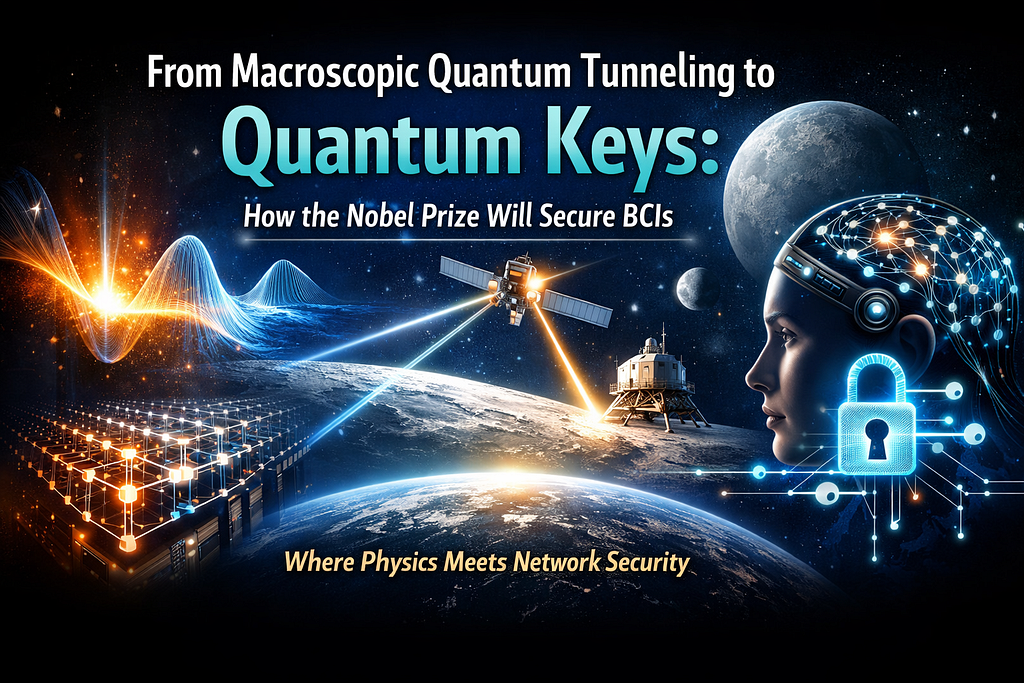
Each time you save a file to flash memory, quantum tunneling happens. Electrons pass through an insulating barrier they shouldn’t have the energy to cross — not by going over, but by existing as probability waves that extend through. The barrier is real. The electron crosses anyway.
This isn’t theory. It’s how your SSD works.
“Quantum tunneling is a phenomenon where particles pass through barriers they don’t have enough energy to climb over.”
*Picture this —*you’re rolling a ball toward a hill. If the ball doesn’t have enough energy to reach the top, it rolls back. Classical physics says the barrier wins. Quantum mechanics says that there’s a probability the ball appears on the other side — not by going over, but by passing through as a probability wave.
*And the time it takes? We call this the “*tunneling traversal time” in Quantum Mechanics.
Now — if quantum tunneling allows particles to pass through barriers they shouldn’t have the energy to cross — and if this effect scales up to macroscopic systems you can hold in your hand — then what’s stopping us from building networks that tunnel data the same way?
Think of a firewall rejecting unauthorized traffic. Classically, a blocked request returns 403 Forbidden — access denied, connection terminated, try again never. The packet hits the wall and stops. Now imagine traffic that doesn’t need permission. It doesn’t probe for open ports or exploit misconfigurations.
It simply appears in the destination network, as if the firewall never existed. Not by exploiting a vulnerability. Not by finding an open port. By existing as a probability that extends through the barrier itself — a probability distribution that collapses into existence wherever it’s observed.
Entangled Questions That Bypass Barriers
What if data could quantum tunnel through barriers — bypassing interception not through computational hardness, but through the fundamental physics of superposition and entanglement?
I followed this question down and what I found was that barriers aren’t absolute. They’re probability gradients. And probability can be manipulated.
Akin to firewalls, the universe also has its set of rules. Those rules operate at specific scales — and understanding where they apply is the difference between science fiction and engineering.
In this piece, I’ll break down what Martinis, Clarke, and Devoret actually discovered and why it matters. Then I’ll trace the line from quantum tunneling to network security to brain-computer interfaces (BCIs) — and ask the question no one’s answering yet: what would a probabilistic, qubit-based secure channel look like, and how would we implement it at the neural boundary?
Quantum security at the BCI boundary remains largely unexplored territory — a new frontier. By applying probabilistic frameworks now, we can begin to map what cybersecurity will need to look like as neural interfaces move from lab to clinic.
Why I’m Writing This: Knowing What We Don’t Know
Before we dive deeper, I want to be transparent about something.
Neil deGrasse Tyson once said in his MasterClass:
“One of the greatest challenges in life is knowing enough to think you’re right, but not enough to know you’re wrong.”
That quote is why this article exists.
Listening to Neil interview John Martinis on StarTalk, I found myself identifying dots between quantum tunneling and network security — between Josephson junctions and VPN protocols — between macroscopic quantum effects and the neural security frameworks I’ve been developing. The connections felt compelling. Maybe too compelling.
I’ve spent considerable time researching about the future of neural security — exploring coherence breaches, the Scale-Frequency Invariant, and threats to brain-computer interfaces. I know enough about quantum mechanics to see tantalizing connections. But do I know enough to know where I’m wrong?
This is my attempt to find out. To map the boundaries of what quantum tunneling can and cannot do for network security. To identify where the physics supports my intuitions — and where it doesn’t. To strategize future directions for my passion project by understanding, honestly, what we’re working with.
So consider this article a public exploration — research notes toward future iterations. The wavefunction hasn’t collapsed yet.
The Nobel-Winning Breakthrough
For decades, physicists assumed quantum tunneling only happened at subatomic scales — electrons, photons, individual particles. John Martinis, working with John Clarke and Michel Devoret at UC Berkeley in 1984–1985, proved something astonishing:
Quantum tunneling can happen in systems large enough to hold in your hand.
Using Josephson junctions— two superconducting metals separated by a thin insulator, cooled to 15 millikelvin — they demonstrated that billions of electrons, behaving as Cooper pairs, could tunnel coherently through barriers as a single quantum entity.
Stop and think about that.
Before Martinis, the quantum world was microscopic — safely contained in atoms and particles too small to see. After Martinis, we knew quantum effects could reach up into the world of things we can touch. That’s not a small shift. That’s a paradigm change. Imagine how this completely redefines the way we view how plants photosynthesize, or better, neurons that don’t wire together fire together!
Tunneling Traversal Time: The Part That Matters
Here’s what caught my attention in the StarTalk episode. Tyson asked Martinis: “Does tunneling happen instantly?”
The answer is no. And the physics of why is crucial.
There’s a traversal. There’s a duration. There’s something happening inside the barrier.
Why This Matters Now.
While classical IT and Security was built on the traditional networking model, the quantum leap across the peak is not as far as it seems. As BCIs connect networks to neurons, as quantum computers break encryption, all this is happening at the exponential rate of Moore’s Law.
The parallel between quantum tunneling and VPN tunneling isn’t just linguistic. It marks the boundary between two eras, Classical and Indeterminance.
The boundaries of the quantum world are further out than we assumed.
In 1984, no one expected quantum effects to manifest in systems you could hold. Martinis, Clarke, and Devoret proved otherwise. Today, we’re building quantum computers with thousands of qubits, distributing quantum keys via satellite, and racing to make our classical infrastructure quantum-resistant.
- If you’re at NASA or a STARCLOUD: How realistic is lunar PSR quantum computing? What infrastructure bottlenecks am I underestimating? What about that data center Starcloud sent to orbit?
Neil was right: the challenge isn’t knowing enough to think you’re right, but not enough to know you’re wrong.
Related articles: — The OSI of Mind: Securing Human-AI Interfaces — Your Brain Has a Spam Filter — Your Brain Needs a Firewall — Neural Ransomware Isn’t Science Fiction — Can Hackers Attack Quantum Computers Across Time and Space?
From Macroscopic Quantum Tunneling to Quantum Keys: How the Nobel Prize Will Secure BCIs was originally published in Cyber Security Write-ups on Medium, where people are continuing the conversation by highlighting and responding to this story.
Written with AI assistance (Claude). All claims verified by the author.