Neural Ransomware Isn't Science Fiction
Why Existing Cybersecurity Frameworks Fall Short for Neural Threats
The technical threat model for holding a brain implant hostage — and why we need to talk about it now.
Picture this— You wake up and something is wrong.
The neural implant that restored your vision after the accident — the one that lets you see your children’s faces — is displaying a message directly into your visual cortex:
“Your device has been locked. Send 2 BTC to the following address within 48 hours or functionality will be permanently disabled.”
You can’t see. You can’t drive. You can’t work. And somewhere, an attacker is waiting for payment.
This isn’t science fiction. Every component of this attack exists today.
Current Defenses Are Inadequate
Most devices rely on “security through obscurity” — proprietary protocols that haven’t been publicly analyzed. This is not security. It’s delayed insecurity. Every proprietary protocol gets reverse-engineered eventually.
Encryption exists but is often limited by power constraints. The implant runs on milliwatts. Strong cryptography burns energy. Trade-offs get made.
Update mechanisms are particularly concerning. How do you patch firmware on something inside someone’s skull? Over-the-air updates are convenient but expand the attack surface. Requiring hospital visits for every security patch is impractical.
And there’s no standard. No BCI equivalent of automotive cybersecurity regulations. No mandatory penetration testing. No bug bounty programs. The industry is moving fast and security is struggling to keep up.
The Truth? This Attack Is Theoretically Feasible
Let’s walk through exactly how it would work.
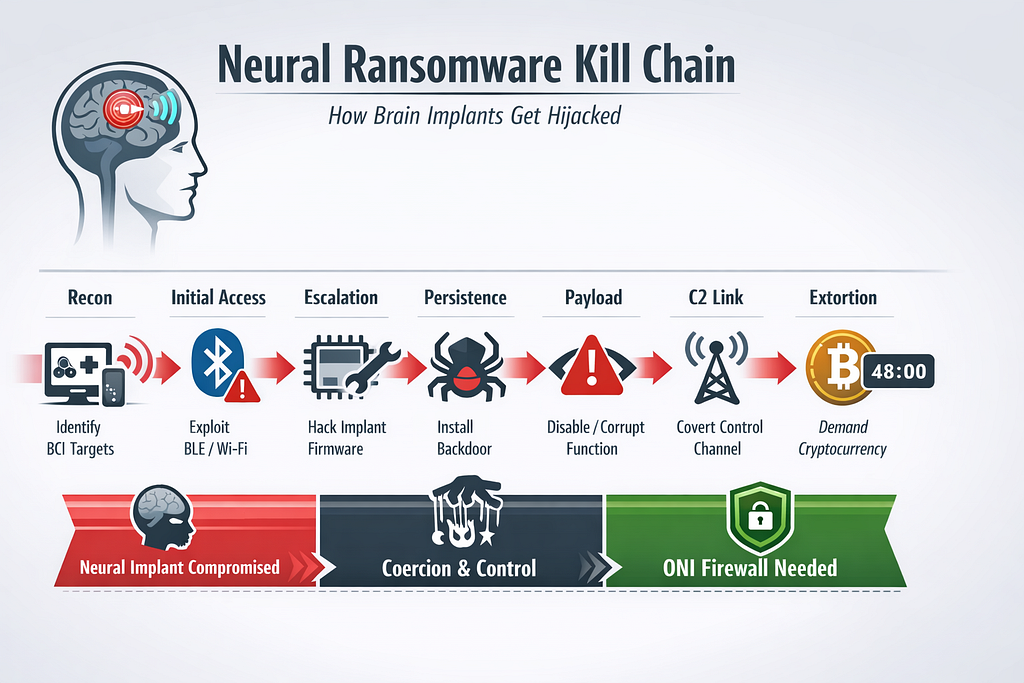
Neural Ransomware Kill Chain
A leading neural implant chip — the one already implanted in human patients — communicates via Bluetooth Low Energy. The same protocol in your wireless headphones. The same protocol that’s been exploited by attacks like BlueBorne, which affected billions of devices in 2017.
BlueBorne didn’t require pairing. It didn’t require user interaction. If your Bluetooth was on, you were vulnerable. Let’s face it, frequency signals don’t exist in the vacuum of space unless there is motion.
Now imagine that vulnerability in something you can’t turn off. Something inside your skull.
Blue Teamers Today vs. Blue Teamers of Tomorrow
The advent of Lockheed Martin’s Cyber Kill Chain (2011) revolutionized the way cybersecurity professionals mitigate against hacks. They paved the way for organizations like MITRE to fill in the gaps with the ATT&CK Matrix (2013–2015).
While Lockheed Martin’s Kill Chain proposes that an attack can be detected or disrupted at any stage of the kill chain, MITRE recognized that it is primarily reactive, not because it can’t be used proactively, but because it is designed to model attacks after or during observation.
What’s missing?
While such frameworks have revolutionized the way security professionals address attack vectors across an array of threat landscapes — they’re designed to address binary-based silicon attacks.
Existing frameworks ask:
- Who sent this?
- What technique is being used?
- What system is compromised?
They do not ask:
- Is this signal coherent, stable, and biologically safe?
My proposal— The ONI Framework which introduces:
- Coherence as a first-class security primitive to identify algorithmic equations for building detections of tomorrow before they emerge via a quantitative trust scoring of signals before execution
- ONI-Compliant Firewall standards and design
In short- Traditional security tolerates:
- Detection after delivery
- Mitigation after execution
- Recovery after damage
Neural systems cannot accept this risk as it impacts livelihood.
How It Works Today
Frameworks like Lockheed Martin’s Cyber Kill Chain, MITRE ATT&CK, and STRIDE fundamentally changed how defenders understand, detect, and respond to attacks. They gave us shared language, repeatable models, and community-wide standards.
Security researchers use “kill chains” to map out attack sequences. Here’s what a neural ransomware attack might look like:
Step 1: Reconnaissance- The attacker identifies targets. Maybe they're scanning for BCI-specific Bluetooth signatures in a hospital waiting room. Maybe they bought a list of patients from a compromised medical database. Neural implant recipients aren't hard to find - many are public about life-changing procedures.
Step 2: Initial Access- A vulnerability in the wireless protocol - Bluetooth, WiFi, or the proprietary link to the external controller. Zero-days in wireless stacks are discovered regularly. The implant industry is small; security research resources are limited.
Step 3: Persistence- The attacker establishes a foothold. They don't want to lose access if the device reboots or the patient moves out of range. They modify firmware, install a backdoor, or compromise the cloud service that manages device updates.
Step 4: Payload Deployment- Now the ransomware activates. The device's therapeutic functions are disabled or degraded. A message is delivered - through the device's own interface if it has one, or through email/text linked to the patient's account.
Step 5: Extortion- Pay or suffer. The attacker demands cryptocurrency. The victim faces a choice: lose the function the implant provides - possibly permanently - or pay the ransom with no guarantee of restoration.
How It Works Tomorrow
The brain is not a replaceable silicon-based endpoint. Neuroscience is only beginning to comprehend the wonders of the mind. With the progression of AI and BCIs, we are getting exponentially closer thanks to Moore’s Law.
Traditional cyber frameworks model how attacks succeed; ONI models when signals should never be allowed to touch neural tissue in the first place.
+-----------------+---------------------------+---------------------------------------------+---------------------------+
| Framework       | What It Does Well         | What It Misses (ONI Gap)                     | OSI-ONI Layer Coverage.   |
+-----------------+---------------------------+---------------------------------------------+---------------------------+
| Kill Chain      | Models attack sequencing  | No biological harm model or neural impact    | L11–L14 (Outcome &        |
|                 | and disruption points     | awareness                                    | Human Sovereignty)        |
+-----------------+---------------------------+---------------------------------------------+---------------------------+
| MITRE ATT&CK    | Catalogs adversary TTPs   | No signal-level validation or coherence      | L3–L7 (Signal Integrity)  |
|                 | across platforms          | checking                                     |                           |
+-----------------+---------------------------+---------------------------------------------+---------------------------+
| STRIDE          | Classifies threat types   | No continuous trust metric or physiological  | L8–L10 (Intent & Context) |
|                 | (spoofing, tampering, etc)| feedback loop                                |                           |
+-----------------+---------------------------+---------------------------------------------+---------------------------+
| Zero Trust      | Strong identity, auth,    | Assumes endpoints are machines, not human    | L0–L2 (Signal Existence)  |
|                 | and access controls       | neural systems                               |                           |
+-----------------+---------------------------+---------------------------------------------+---------------------------+
| ONI Framework   | Enforces signal trust     | N/A – designed for biological systems by     | L0–L14 (Full-stack        |
| (This Work)     | before neural contact;    | default; designed for physiological safety,  | neural protection:        |
|                 | continuous coherence and  | coherence, and human agency                  | signal → outcome → agency)|
|                 | outcome monitoring        |                                              |                           |
+-----------------+---------------------------+---------------------------------------------+---------------------------+
Introducing the ONI’s Neural Signal Assurance Model (NSAM)
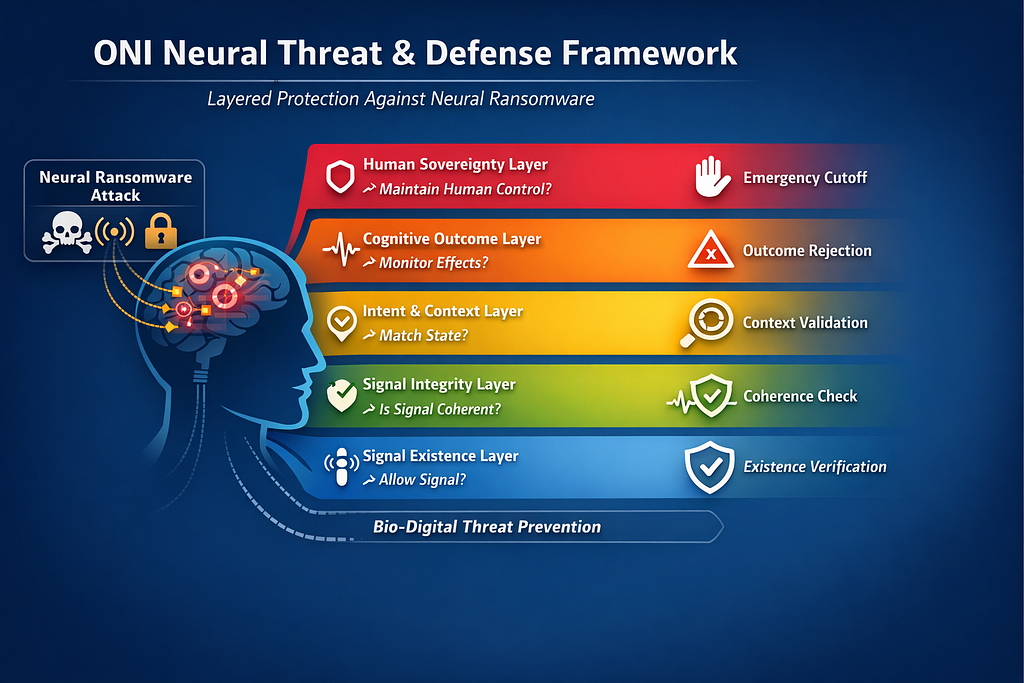
Instead of a linear chain, ONI uses a layered interference map that aligns with the L0–L14 Organic Neural Interface layers. The key is that ONI complements existing frameworks and operates at a different layer — true defense-in-depth.
Think of it this way:
Modern Kevlar outperform medieval steel armor not by being harder, but by dispersing energy across layered, flexible structures made of Carbon, Hydrogen, Oxygen, and Nitrogen. Medieval steel armor, by contrast, was primarily composed of only two elements: Iron and Carbon.
See the relationship?
Layered defenses don’t just provide a fail-safe through multiple barriers — they use the bonds between layers, the “glue” that holds the system together, to enhance overall efficacy.
ONI works the same way: it adds cohesion across the protective layers of neural interfaces, ensuring attacks are absorbed, filtered, and neutralized before causing harm.
Why Kill Chains Are Not Enough
The Cyber Kill Chain proposes that an attack can be detected or disrupted at any stage — reconnaissance, delivery, exploitation, and so on.
That works well for enterprise networks, but neural threats don’t behave like linear intrusions. They don’t “progress.” They accumulate influence.
A neural attack doesn’t need persistence, lateral movement, or data exfiltration. It needs only one thing:
A signal that reaches the brain.
Once that happens, the damage may already be irreversible.
ONI Reframes the Threat Model
ONI replaces the idea of a “kill chain” with a neural kill surface — a set of physiological checkpoints that every signal must pass before it reaches the brain.
To address the limitations of existing cyber threat frameworks when applied to neural interfaces, we introduce the Neural Signal Assurance Model (NSAM). NSAM is a physiology-first defense framework that evaluates the legitimacy of neural signals prior to cortical interaction, enforcing continuous coherence, contextual validity, and human agency across all layers of the Organic Neural Interface (ONI) stack.
This shifts defense from reactive detection to preventive enforcement.
Neural Ransomware Example (NSAM / ONI Early Interdiction)
Attack Scenario: A compromised neural interface attempts to coercively restrict motor function by injecting sustained, phase-locked stimulation into motor cortex circuits. Normal motor output is conditionally restored only upon fulfillment of an external demand, constituting a form of neural ransomware.
Traditional Detection (Kill Chain / MITRE): The attack is identified after functional degradation is observed, during behavioral anomaly analysis or post-incident investigation.
NSAM / ONI Interdiction Points:
- L3 — Signal Integrity: Abnormal phase coherence patterns trigger rejection due to elevated phase variance (σ²φ).
- L8 — Intent & Context: Stimulation commands fail contextual validation, as imposed motor inhibition does not align with the user’s cognitive or physiological state.
- L11 — Cognitive Outcome: Observed motor suppression diverges from expected outcomes for the current cognitive context, initiating automatic signal termination.
Result: Malicious stimulation is blocked prior to sustained neural engagement. Motor control remains intact. No coercive leverage is achieved. No ransom condition can be enforced.
Layer numbers follow the QIF v2.0 model (L1–7: OSI networking, L8–14: neural extension).
Why This Works Scientifically
- Avoids anthropomorphizing the attack
- Defines ransomware by coercive functional restriction
- Grounds defense in measurable signal properties and outcomes
- Cleanly contrasts reactive detection vs preventive interdiction
ONI prevents the harm earlier:
- Phase anomalies are rejected
- Context mismatches are blocked
- Unsafe outcomes trigger instant cutoff
The attack fails before the brain is affected.
The ONI Neural Defense Layers (Simplified)
1. Signal Existence
“Should this signal exist?”
- Is there real physical energy?
- Does it match expected RF + electrochemical behavior?
- Is this a replay, reflection, or phantom signal?
No signal is trusted simply because it arrived.
2. Signal Integrity
“Is this signal biologically plausible?”
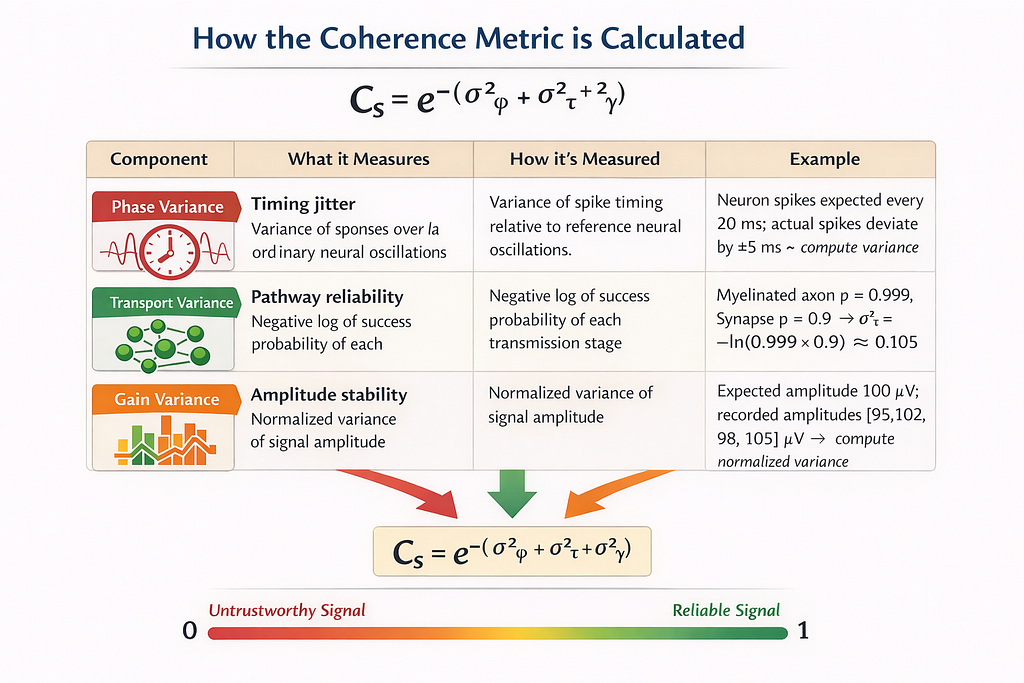
- Phase variance → timing jitter
- Transport variance → pathway reliability
- Gain variance → amplitude stability
Authentication is not enough. The signal itself must make sense.
3. Intent & Context
“Does this signal make sense right now?”
- Correct signal, wrong brain state = reject
- Valid command, wrong cognitive context = reject
Context becomes part of security.
4. Outcome Monitoring
“What effect is this signal causing?”
- Unexpected motor output
- Emotional hijack
- Pain or seizure risk
If outcomes diverge, control is revoked immediately.
5. Human Sovereignty
“Does the human retain agency?”
- Hardware-enforced biological override
- One-way safe mode
- Human always outranks software
The brain must always be able to say “no.”
Why Neural Ransomware Is Worse Than Regular Ransomware
When ransomware hits your laptop, you lose access to files. It’s painful, expensive, sometimes devastating — but it’s recoverable. You can wipe the drive, restore from backup, buy a new machine.
When ransomware hits your neural implant, you lose access to yourself.
You can’t just “turn it off.” Many implants manage critical functions. Deep brain stimulators control Parkinson’s tremors. Cochlear implants provide hearing. Retinal implants provide vision. Turning them off isn’t an inconvenience — it’s a medical emergency.
You can’t easily replace it. These devices require surgery to implant and surgery to remove. The brain may have adapted to the implant over months or years. Removal isn’t just expensive — it may be medically risky.
The leverage is absolute. Regular ransomware holds your data hostage. Neural ransomware holds your body hostage. Your ability to see, hear, move, think. The psychological pressure is incomparable.
There’s no “restore from backup.” Your brain’s neural pathways have been physically modified by the implant. Even if you could restore device firmware, you can’t restore the biological changes that occurred during calibration.
The Economics Favor Attackers
Here’s the uncomfortable math:
A neural implant costs $50,000 to $150,000. Surgery adds another $50,000+. Insurance may or may not cover it. The patient has made an enormous investment — financial, physical, emotional.
Now an attacker demands $10,000 in Bitcoin.
What do you do? Fight it on principle while you can’t see? Hire lawyers while your tremors return? Wait for the manufacturer to issue a patch while your quality of life collapses?
Most people will pay. The attacker knows this.
And unlike laptop ransomware, there’s no IT department to call. No “restore from Time Machine.” No buying a new one at Best Buy. The asymmetry is total. At least, not yet.
It Gets Worse: Beyond Simple Lockout
Locking the device is the simplest attack. But once an attacker has control of something inside your head, other possibilities emerge:
Degradation attacks. Instead of full lockout, the attacker slowly reduces functionality. Your vision gets slightly worse each day. Your tremor control becomes slightly less effective. You might not even realize it’s an attack — until the ransom note arrives.
Data exfiltration. BCIs don’t just write to the brain — they read from it. An attacker could record and sell your neural activity patterns. What are your thoughts worth to an advertiser? An employer? A government?
Manipulation attacks. If the implant can stimulate neural tissue, an attacker could theoretically influence mood, perception, or behavior. Pay us, or we’ll make you feel afraid every time you try to leave your house.
Destruction. The nuclear option: deliberately damaging neural tissue through malicious stimulation patterns. “Pay or we permanently blind you.” This crosses from extortion into something closer to assault — but the technical capability may exist.
What Would Actually Help
This isn’t hopeless. But it requires taking the threat seriously before it becomes a crisis.
Hardware-enforced safety limits. Analog circuits that physically prevent dangerous stimulation patterns, regardless of what firmware says. No software should be able to override hardware safety bounds. This is the last line of defense when everything else fails.
Cryptographic device identity. Each implant should have a unique, hardware-rooted cryptographic identity that cannot be cloned or spoofed. Commands must be signed by authorized keys. Unauthorized commands get rejected at the hardware level.
Local-first architecture. Critical functions should work without network connectivity. If the cloud service goes down — or gets compromised — the implant should continue functioning in a safe mode. No single point of failure outside the patient’s body.
Transparent security research. The BCI industry needs to embrace security researchers, not threaten them with lawsuits. Bug bounty programs. Responsible disclosure policies. Published security audits. Obscurity isn’t working.
Regulatory requirements. The FDA approves BCIs for safety and efficacy. Security should be part of that approval. Mandatory threat modeling. Required penetration testing. Incident reporting obligations. Make security a condition of market access.
This Is Why The World Needs A Neural Firewall
Previously, I introduced the Coherence Metric — a way to mathematically evaluate whether a neural signal should be trusted. But coherence is just one layer of defense.
The ONI (Organic Neural Firewall) framework I’m developing treats the BCI as what it is: a network interface into your nervous system. And like any network interface, it needs a firewall.
That firewall operates at the boundary between silicon and synapse. It inspects every signal in both directions. It validates cryptographic signatures. It checks coherence scores. It enforces rate limits and safety bounds. It logs everything for forensic analysis.
Most importantly, it fails safe. If something seems wrong — if authentication fails, if coherence drops, if patterns look suspicious — the firewall blocks the signal and alerts the user. Better a false alarm than a successful attack.
Neural ransomware is coming. The question isn’t whether, but when. The time to build defenses is now — before the first victim’s ransom note appears in their visual cortex.
What You Can Do
If you’re a patient or potential patient: Ask your device manufacturer about their security practices. What encryption do they use? How do they handle firmware updates? What happens if there’s a security incident? You have a right to know.
If you’re in the BCI industry: Take this seriously. Hire security engineers. Commission penetration tests. Establish bug bounty programs. Don’t wait for the first attack to make security a priority.
If you’re a policymaker: Start thinking about regulatory frameworks. BCIs are medical devices that are also networked computers. They need security requirements that reflect both identities.
If you’re a security researcher: This field needs you. The attack surface is enormous and largely unexplored. Your skills could literally protect people’s minds.
The brain-computer interface is here, the next frontier. Let’s make sure we’re ready.
Edit: 2/1/26- ONI is being deprecated and replaced with a future-proof model accounting for Quantum Indeterminancy.
Written with AI assistance (Claude). All claims verified by the author.
Neural Ransomware Isn’t Science Fiction was originally published in Cyber Security Write-ups on Medium, where people are continuing the conversation by highlighting and responding to this story.