Your Brain Needs a Firewall — Here's What It Would Look Like
Your Brain Needs a Firewall — Here’s What It Would Look Like
The same security principles that protect your computer will soon need to protect your mind.
In 2024, a man with a neural implant controlled a computer cursor with his thoughts. By 2025, patients were typing, browsing, and playing games — all without moving a muscle.
This is incredible. It’s also terrifying.
Because if a device can read your brain, it can probably write to it too. And anything that can be written to can be hacked.
The Attack Surface Inside Your Skull
A leading neural implant chip has 1,024 electrodes. It reads 20,000 brain samples per second. It communicates via Bluetooth.
Bluetooth. The same protocol that’s been exploited by attacks like BlueBorne, Bluebugging, and Bluesnarfing.
Security researchers have already identified what’s possible:
- Thought eavesdropping — intercepting neural signals to extract memories or passwords
- Command injection — sending fake signals to trigger involuntary movement or speech
- Emotional manipulation — stimulating fear, pleasure, or anxiety centers
- Neural ransomware — locking the implant until you pay
This isn’t science fiction. These are documented attack vectors published by security researchers (cited source needed) in 2025.
Why Traditional Security Won’t Work
Here’s the problem: your brain isn’t a server. You can’t patch it. You can’t air-gap it. You can’t reinstall the operating system.
If malicious code reaches your neural tissue, the damage is physical. There’s no undo button.
Traditional perimeter security assumes you can trust your internal network. But when your “internal network” is your actual neurons, that assumption fails catastrophically.
We need something different. We need Zero Trust — for the brain.
Introducing the Neural Firewall
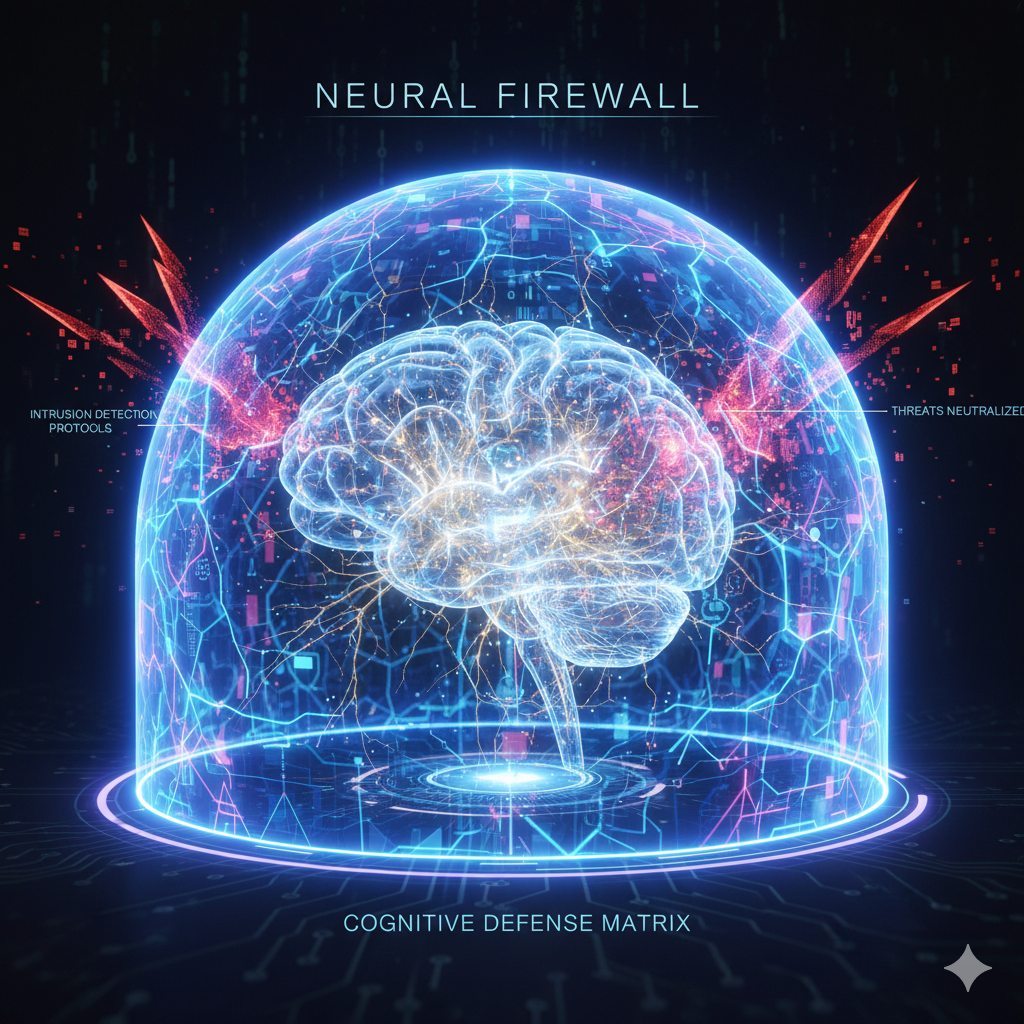
I’ve been developing a framework called ONI (Organic Neural Interface) that treats brain-computer interfaces the way we treat network infrastructure — with layers, boundaries, and trust zones.
The core insight: BCI electrodes are edge nodes.
Just like a firewall sits at the boundary between your internal network and the internet, a neural firewall would sit at the boundary between your neural tissue and the digital world.
What the Firewall Actually Does
For incoming commands (WRITE path):
- Authentication — Is this command from an authorized source?
- Authorization — Is this source allowed to stimulate this brain region?
- Safety bounds — Is the amplitude/frequency within safe limits?
- Rate limiting — Are we exceeding stimulation thresholds?
- Pattern matching — Does this look like a known attack signature?
If any check fails: reject, log, alert.
For outgoing signals (READ path):
- Anomaly detection — Is this normal neural activity or a seizure/attack?
- Privacy filtering — Strip sensitive data before transmission
- Encryption — Secure everything before it hits Bluetooth
The Hard Part: It Has to Fit on a Chip
The implant runs on 25 milliwatts. That’s nothing.
The firewall has to:
- Process in real-time (<1ms latency)
- Use minimal power (<5mW)
- Fit on a ~1mm² silicon area
This means the heaviest security processing has to happen on-device. You can’t rely on the cloud — by the time a malicious command reaches a remote server for analysis, the damage is done.
Hardware-enforced safety limits become the last line of defense. If software is compromised, the hardware physically prevents dangerous stimulation patterns.
Why This Matters Now
Brain-computer interfaces (BCIs) are already in human trials. The FDA has granted Breakthrough Device designation to multiple BCI projects. Companies are racing toward consumer deployment.
We have MITRE ATT&CK for cyber threats. We have Zero Trust for cloud architecture. We have OSI for network communication.
We are unaware of a published framework designed specifically for neural interfaces.
The ONI Framework is my attempt to fill that gap — to create the security architecture before the first neural exploit, not after.
Edit 2/1/26: ONI is being deprecated and phased out with a more future-proof model accounting for quantum interdeterminancy.
Written with AI assistance (Claude). All claims verified by the author.