The OSI of Mind: Securing Human-AI Interfaces
OSI of Mind: A Framework for Securing Neural Interfaces
What happens when we apply cybersecurity thinking to the brain?

“The OSI of Mind”
If you’ve worked in IT, you know the OSI model — seven layers that standardize how computers communicate. It’s how we reason about everything from physical cables to application exploits.
Layered abstractions have proven effective across domains. When two systems interface, the model must span both. OSI was built for silicon. Silicon is now in the brain.
This isn’t hypothetical. Multiple BCI companies have implanted their first human patients. Several are in FDA trials. Neural implants have been in human brains since 2004.
These devices are tested for safety and efficacy. They are not tested against adversarial threats.
Here’s The Problem We Need To Ask
Existing neuroethics frameworks address important questions: informed consent, cognitive liberty, mental privacy. What they don’t address is adversarial security at the signal layer.
- What does a malicious input look like at the neural interface?
- How do we authenticate signals between device and brain?
- Where are the layer boundaries, and what are the attack surfaces at each?
We have no shared vocabulary for these questions.
A Proposed Starting Point
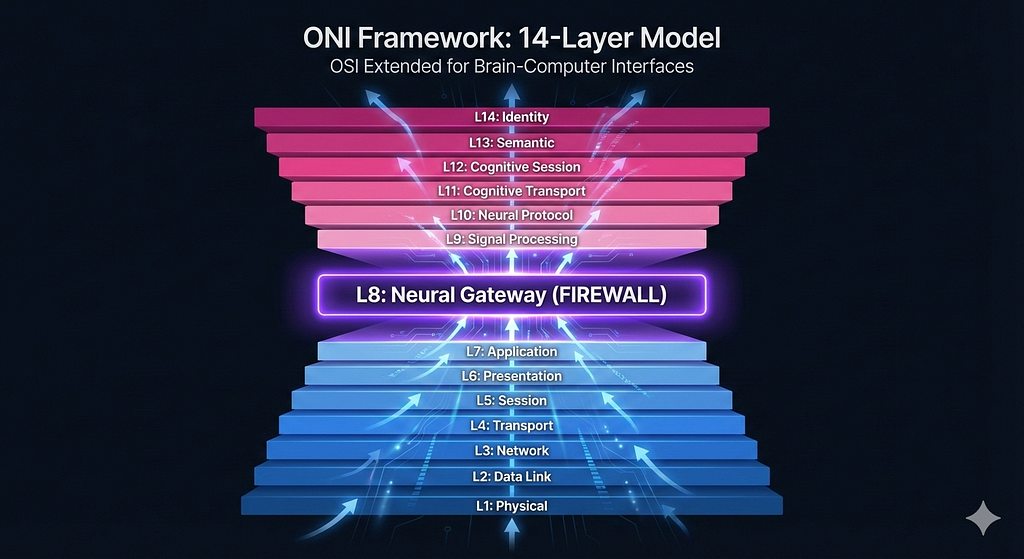
I’m publishing an open framework called QIF a 14-layer model that extends the OSI stack into biological territory. Each layer has characteristic frequencies, spatial scales, and critically — attack surfaces.
- Layers 1–7: Traditional OSI
- Layers 8–10: Neural interface domain (electrodes, local field potentials, oscillatory patterns)
- Layers 11–14: Cognitive domain (working memory, attention, executive function, identity)
This is not a finished product. It’s a scaffold that needs neuroscientists, AI safety researchers, and BCI engineers to stress-test, correct, and extend.
Why This Matters
Brain-Computer Interfaces have no shared structure yet. And I kept asking myself: if we’ll eventually need to secure the brain-machine boundary, shouldn’t we have a framework before the first zero-day exploit of the mind?
Furthermore, BCIs are FDA Class III medical devices. They require extensive testing. But what are we testing against across the Neuro-Bio layer that uses a universal shared language across multi-modal interdisciplinaries?
Without a framework, we’re flying blind. With one, we can:
- Anticipate attack vectors before they’re exploited
- Design security at every layer boundary
- Align with existing compliance regimes
This isn’t science fiction, it’s systems engineering.
Read the full paper. Poke holes in it. Help me make it better.
I’m sharing this framework to start a conversation. I don’t have all the answers (the biological layers need input from neuroscientists), but I believe the security community has a role to play in shaping how humanity entangles with technology as we bridge into the Era of BCIs.
Edit 2/1/26: ONI just evolved to it’s next form, ONIX (just kidding about the name). Check Qinnovate.com for details! You won’t want to miss this.
Written with AI assistance (Claude). All claims verified by the author.